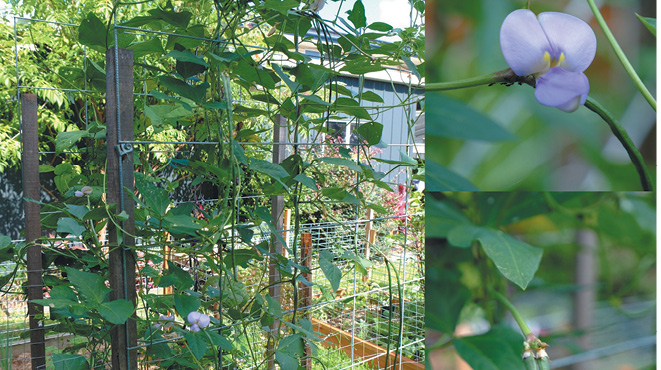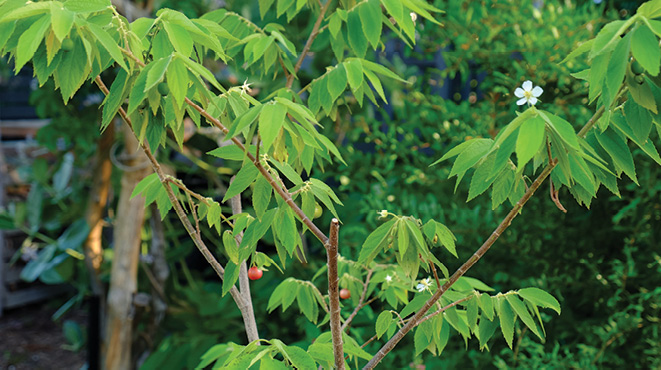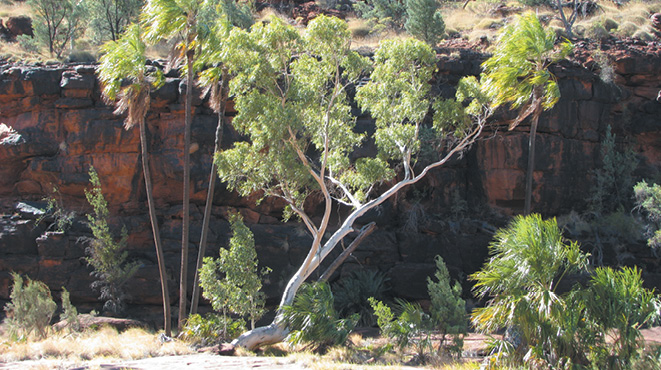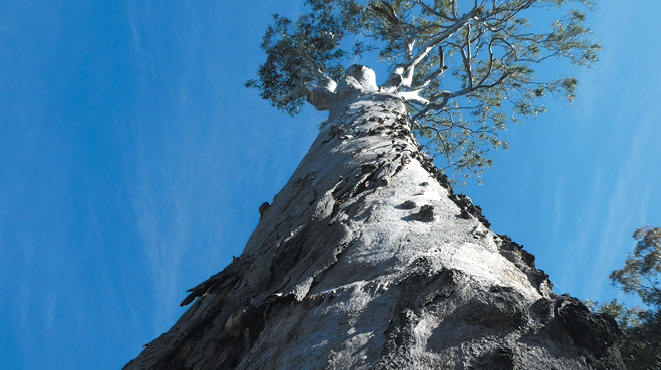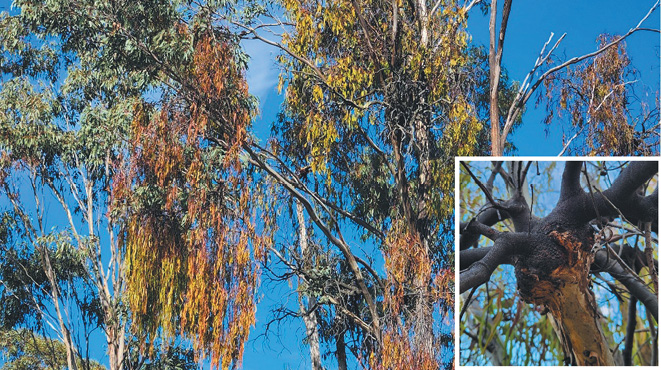
The mistletoe has a different leaf shape – it has droopy clusters of leaves hanging down and is more yellow in colour, whilst the gum tree’s leaves are a greeny-grey colour. Inset: The mistletoe branches are the darker branches on top and have grown into the pale-coloured host branch. Photo: Kat Pearson.
BY KAT PEARSON, GIRL IN THE GREEN
When someone says mistletoe – especially at this time of the year – most likely your thoughts go straight to a bunch of green above an English doorway and the chance encounter with a dreamy Hugh Grant-esque bloke. Or maybe that’s just me.
Mistletoe is a common name for a freeloading bunch of plants that grow on ‘host’ trees or shrubs. They are hemiparasitic organisms that send their root-like haustoria into the host and suck the water and nutrients they need. Because most mistletoes have leaves, they can perform some level of photosynthesis on their own (hence the ‘hemi’ part). There are around 1500 species worldwide.
English mistletoe (Viscum album) mostly grows on trees like hawthorn, apple, and poplar. Whilst its hosts are deciduous and lose their leaves in winter, the mistletoe is evergreen and obvious during the Northern Hemisphere holiday period.
Of course, us Aussies like to do things our own way. We have about 90 species, all of which are endemic (found here and nowhere else) and – because things are bigger down under – we also have the largest. The Western Australian Christmas tree or mungee (Nuytsia floribunda) looks like a tree, growing up to 10m tall with a trunk over 1m wide. It attaches itself to the roots of other trees (sometimes over 150m away).
Closer to home, we are more likely to see mistletoe in eucalypts. Look closely and you may see a tree that seemingly has a branch with a different leaf type – that’s probably mistletoe!
Mistletoes are spread by birds, with seeds excreted in poop. The seed sticks to a branch, germinates, and voila! A new plant is formed. Some mistletoes are host-specific, which means they will only grow on a certain species of tree, whilst others will grow on a wide range of plants. They usually will not kill their host, but may cause some local stunting. If you are lucky enough to have one growing in one of your own trees, don’t remove it. Embrace the biodiversity. Mistletoes are an important part of our ecosystem and provide food and habitat for insects and animals. And who knows, you might find yourself standing underneath it, “just a girl, standing in front of a boy ….”.